SLCM Submits Confidential Draft Papers to SEBI for Upcoming IPO
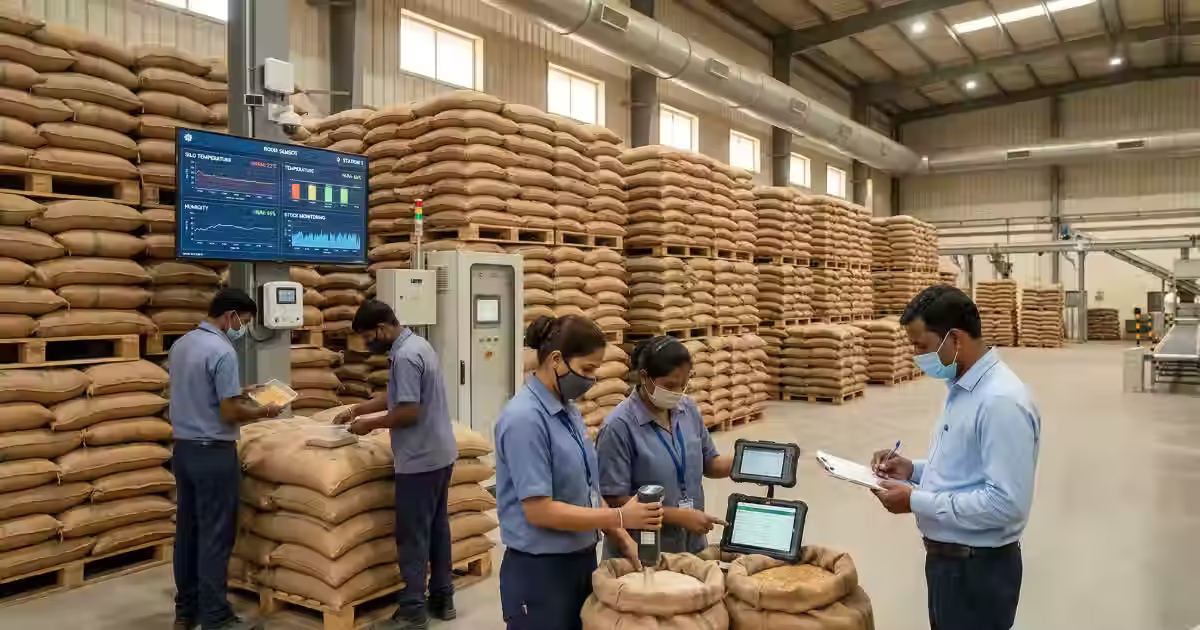
Sohan Lal Commodity Management has submitted confidential draft papers with SEBI for a mainboard IPO. The technology-driven agri-warehousing company operates over 17,000 warehouses across India and Myanmar, handling 1,300+ agricultural commodities.
SLCM Opts for Confidential Route in IPO Filing Process
Sohan Lal Commodity Management Limited has taken a significant step toward public markets by filing confidential draft papers with the Securities and Exchange Board of India for an initial public offering. The company has chosen the relatively new confidential pre-filing route, which allows it to seek regulatory feedback without immediate public disclosure of its offering documents.
The agri-warehousing and logistics company submitted its pre-filed draft red herring prospectus with SEBI and stock exchanges for a proposed mainboard listing. This filing marks the company's formal entry into the IPO process after nearly 17 years of operations as a privately held enterprise.
Under the confidential filing mechanism, SLCM can engage with regulators for early-stage feedback while maintaining privacy around key commercial details. The company will eventually make its offering documents public when it decides to proceed with the actual public subscription period, subject to market conditions and regulatory clearances.
The confidential route has gained traction among companies seeking flexibility in their listing strategies. This approach allows issuers to refine their disclosures, adjust valuation expectations, and time their market entry based on prevailing conditions without facing early public scrutiny of their financial and business information.
Understanding the Confidential Pre-Filing Route
The confidential IPO filing mechanism was introduced by SEBI in November 2022 through a regulatory amendment aimed at making the public listing process more flexible for companies. This route represents an adoption of practices that have been commonplace in developed markets like the United States for many years.
Under traditional IPO procedures, companies file their draft red herring prospectus publicly from day one. This document contains detailed information about the business, financials, promoters, risk factors, and proposed use of proceeds. Once filed publicly, this information becomes available to competitors, analysts, media, and the general public.
The confidential route changes this dynamic by allowing companies to submit their preliminary documents privately to SEBI and stock exchanges. Only the regulator and designated exchange officials have access to these filings during the initial review phase. This provides companies with a space to iterate on their disclosures and address regulatory queries without public exposure.
SEBI reviews the confidentially filed documents and issues its observation letter containing feedback and required modifications. Companies can then incorporate these changes before deciding whether and when to make the documents public and proceed with the actual IPO launch.
This mechanism offers several strategic advantages for issuers. It reduces reputational risk if the company decides to postpone or withdraw the offering due to unfavorable market conditions. It prevents competitors from accessing sensitive business information prematurely. It also allows companies to test market appetite and refine messaging before committing to firm timelines.
For SLCM, adopting the confidential route suggests a measured approach to public market entry. The company can use this period to secure regulatory approval while retaining flexibility about timing the actual market launch based on investor sentiment and sector dynamics.
SLCM's Business Model and Market Position
Founded in 2009, Sohan Lal Commodity Management operates as a technology-enabled agri-warehousing and logistics platform focused on post-harvest management solutions for India's agricultural ecosystem. The company was established by Sandeep Sabharwal, who identified significant gaps in agricultural infrastructure and commodity financing during his experience running a family food processing business.
The company provides comprehensive services spanning scientific storage, fumigation, quality testing, certification, and financing through warehouse receipt-based mechanisms. This integrated approach addresses multiple pain points in the agricultural value chain that have historically plagued Indian farmers and commodity traders.
SLCM's warehouse management platform is equipped with state-of-the-art technology for monitoring, tracking, and protecting agricultural commodities. The company employs digital inventory management systems, automated voice-based processes, and real-time transaction monitoring across its network of facilities.
According to publicly available information about the company's operations, SLCM manages a network of over 17,000 agri-warehouses across 13 Indian states. In addition to its domestic footprint, the company has established operations in Myanmar, where it oversees approximately 350 diversified warehousing facilities combining agricultural and non-agricultural storage.
The company has successfully positioned itself as the only Indian agri-logistics player with international operations. In Myanmar, SLCM manages a network of industrial zones covering substantial area and handling both agricultural and non-agricultural commodities with significant throughput capacity.
SLCM's service offerings cater to a wide range of stakeholders across the agricultural ecosystem. This includes farmers seeking storage solutions and financing, processors and millers requiring inventory management, traders and exporters needing quality assurance, commodity exchanges requiring collateral management, and central and state government agencies implementing procurement programs.
The company has handled over 1,300 different agricultural commodities throughout its operational history. This diverse portfolio includes cotton, wheat, pulses, maize, spices, castor seeds, barley, bajra, and various other crops grown across different agro-climatic zones of the country.
Technology Integration and Digital Infrastructure
A distinguishing feature of SLCM's business model is its emphasis on technology integration across operations. The company has built what it describes as a "phygital" ecosystem that combines physical warehousing infrastructure with comprehensive digital workflows and automation.
The company's warehouse management platform includes digital inventory tracking systems that provide real-time visibility into stock levels, quality parameters, and movement of commodities across the network. This technology infrastructure enables efficient coordination between geographically dispersed facilities.
SLCM has implemented automated processes for various operational functions. The company uses voice-based systems for recording and tracking transactions, reducing manual intervention and improving accuracy in high-volume environments. These systems operate around the clock, providing continuous processing capabilities.
Remote monitoring capabilities represent another technological advantage. The company has deployed surveillance systems across its warehouse network to ensure security and compliance with storage protocols. These monitoring solutions help prevent malpractices and provide stakeholders with confidence in the integrity of stored commodities.
Quality control functions are also technology-enabled. SLCM operates accredited laboratories for physical and chemical testing of agricultural commodities. These facilities ensure that stored products meet required quality standards and help in detecting issues like moisture content, contamination, or pest infestation early in the storage cycle.
The company has developed mobile application-based solutions that provide stakeholders with access to information and services through digital interfaces. These platforms facilitate transactions, enable transparency in operations, and improve accessibility for participants across the agricultural value chain.
For financing operations, SLCM's technology infrastructure supports assessment of commodity values, collateral management, and loan processing workflows. The digital systems enable faster credit decisions and streamline the documentation required for warehouse receipt-based lending.
Financial Services Through Kissandhan
In addition to warehousing and logistics operations, SLCM operates a financial services vertical through its subsidiary Kissandhan, which functions as a Reserve Bank of India regulated Non-Banking Financial Company. This NBFC focuses on providing credit to agricultural stakeholders using innovative collateral mechanisms.
The core product offering from Kissandhan is commodity-based financing, where loans are extended against stored agricultural commodities rather than traditional collateral like land or financial assets. Under this model, farmers and traders can deposit their produce in SLCM-managed warehouses and receive financing against the warehouse receipts issued for the stored goods.
This financing approach addresses a critical gap in agricultural credit markets. Conventional lenders often hesitate to finance farmers due to difficulties in assessing creditworthiness and challenges in recovering dues. By using the commodity itself as collateral, which has an established market value and can be quickly liquidated if needed, the credit risk profile changes significantly.
The warehouse receipt-based financing model provides multiple benefits for farmers. It reduces pressure for distress selling of produce immediately after harvest when prices are typically depressed. Farmers can store their commodities, access working capital for their needs, and choose to sell when market prices improve. This helps in income stabilization and reduces exploitation by intermediaries.
For lenders, the model offers tangible security in the form of physically stored and monitored commodities. SLCM's infrastructure ensures quality maintenance during storage, reducing the risk of collateral deterioration. The company's presence across multiple states enables geographic diversification of lending exposure.
Through its financial services operations, SLCM has reportedly disbursed loans worth substantial amounts over the years, providing liquidity to agricultural markets and enabling stakeholders to optimize their working capital deployment. The company works in partnership with various banks and financial institutions that provide underlying funding for these commodity-backed loans.
Certifications and Quality Standards
SLCM's operations are backed by multiple international quality certifications that validate its processes and service delivery capabilities. The company has secured ISO 9001:2015 certification for quality management systems, ISO 22000:2018 for food safety management, and ISO 33000 for collateral management.
Environmental and safety certifications include ISO 14001:2015 for environmental management systems and ISO 45001:2018 for occupational health and safety. More recently, the company has also obtained ISO/IEC 27001:2022 certification for information security management, reflecting the importance of data protection in its digitally-enabled operations.
In addition to ISO certifications, SLCM holds licenses and accreditations from various government bodies. The company is licensed by the Food Safety and Standards Authority of India for handling food commodities. It is also accredited by the Warehousing Development and Regulatory Authority in the private sector category.
These certifications are not merely compliance checkboxes but represent operational capabilities that differentiate SLCM in the market. The food safety certification enables the company to handle commodities destined for human consumption with adherence to stringent protocols. The collateral management certification validates the company's ability to safeguard assets pledged to financial institutions.
The environmental certifications demonstrate commitment to sustainable practices in warehouse operations. Given that agricultural warehouses consume energy for climate control and fumigation processes, maintaining environmental standards helps in reducing the carbon footprint of operations.
Government Scheme Participation and Contracts
SLCM actively participates in various government procurement and support programs related to agricultural commodity management. The company works as an empanelled vendor under state renewable energy agencies and agricultural marketing boards across multiple states.
One area of government engagement involves management of commodities procured under minimum support price schemes. State agencies purchase crops from farmers at guaranteed prices and require professional warehouse management to store these procurement stocks until they are distributed or sold. SLCM provides these management services under contractual arrangements.
The company also participates in programs related to buffer stock management for strategic commodities. Government agencies maintain reserves of certain agricultural products to stabilize markets and ensure food security. Professional warehousing services are essential for preserving the quality of these stocks over extended periods.
Private sector engagements form another significant component of SLCM's business. The company has been contracted by major agricultural trading companies and processors for commodity storage and management services. These include partnerships with multinational corporations that require reliable logistics infrastructure in emerging markets.
The diversity of clients across government bodies, commodity exchanges, corporate houses, and individual farmers provides revenue stability and reduces concentration risk in the business model. Different client segments have varying seasonal patterns and service requirements, which helps in optimizing asset utilization across the warehouse network.
Conversion to Public Limited Company
In July 2024, SLCM registered as a public limited entity, converting from its previous private company structure. This conversion represents a preparatory step that companies typically undertake when planning to access public equity markets through an IPO.
The transition from private limited to public limited company status involves changes in governance structures, disclosure requirements, and regulatory compliance obligations. Public limited companies must maintain higher standards of financial reporting, corporate governance practices, and shareholder communication compared to private entities.
This structural change signals the company's strategic intent to pursue a public market listing. The conversion occurred well ahead of the confidential IPO filing, allowing management adequate time to establish appropriate systems and processes that will be required post-listing as a publicly traded entity.
For existing shareholders, the conversion to public limited status provides a pathway for eventual liquidity through the stock market. SLCM has raised funding from institutional investors over multiple rounds since its inception. These investors typically seek exit opportunities through IPO listings or secondary sale transactions.
The company's shareholder base includes marquee institutional investors from India and abroad. Past funding rounds have involved participation from venture capital firms and impact investors focused on agricultural value chain improvements. The IPO provides these investors with an opportunity to monetize their investments while potentially retaining part of their holdings for participation in future value creation.
Industry Context and Market Opportunity
The agricultural warehousing and post-harvest management sector in India operates within a context of significant infrastructure deficits and modernization needs. Post-harvest losses in Indian agriculture have been estimated at substantial percentages of total production, representing economic value destruction and food wastage.
Inadequate storage facilities have been a persistent challenge. Traditional warehouses often lack proper ventilation, pest control, and moisture management capabilities. This results in quality degradation, contamination, and physical losses during storage periods. The economic impact extends beyond the immediate loss of produce to include distress selling and income reduction for farmers.
The financing gap in agriculture represents another critical challenge that companies like SLCM address. Despite agriculture being a priority sector for bank lending, credit flow to small and marginal farmers remains constrained. Traditional lending models struggle with the high transaction costs and risk assessment difficulties inherent in agricultural finance.
Government initiatives have sought to address these infrastructure and financing gaps through various schemes and incentives. The Warehousing Development and Regulatory Authority was established to regulate and promote scientific warehousing infrastructure. Commodity markets were developed to provide price discovery mechanisms and enable farmers to access futures markets.
The Private Entrepreneurs Guarantee scheme allows private sector warehouse operators to participate in government procurement operations. This creates commercial opportunities for professional warehousing companies while expanding the overall capacity available for public distribution systems and buffer stock management.
Technology adoption in agricultural logistics represents a relatively recent trend that companies like SLCM are driving. Digital platforms for warehouse management, quality testing, and commodity financing were uncommon a decade ago. The integration of these technologies improves efficiency, reduces losses, and enables scaling of operations across geographies.
The market opportunity extends beyond domestic operations. Several developing countries in Asia and Africa face similar agricultural infrastructure challenges. SLCM's presence in Myanmar demonstrates the potential for Indian agri-logistics companies to export their capabilities and business models to neighboring markets.
Challenges and Competitive Landscape
While the agricultural warehousing sector offers significant opportunities, it also presents operational and business challenges that companies must navigate. The capital-intensive nature of warehouse infrastructure requires substantial investment in land, construction, equipment, and technology systems before generating returns.
Working capital requirements can be substantial, particularly for companies that finance commodity storage through their NBFC subsidiaries. Managing the mismatch between loan disbursements and recoveries requires access to adequate funding lines from banks and financial institutions.
Regulatory complexity adds another layer of challenge. Companies operating across multiple states must comply with varying regulations related to warehousing licenses, food safety standards, weights and measures, and commodity storage. Maintaining compliance across a dispersed network requires robust systems and expertise.
Commodity price volatility affects the collateral value of stored goods, creating risk management requirements for companies providing warehouse receipt-based financing. Sudden price declines can erode the value of pledged commodities, potentially creating credit losses if borrowers default.
The competitive landscape includes traditional warehouse operators, newer technology-enabled platforms, and cooperative storage facilities run by farmer producer organizations. Each category of competitor brings different strengths, whether in local market knowledge, digital capabilities, or cost structures subsidized by government support.
Large agricultural trading companies sometimes develop captive warehousing capabilities, reducing their dependence on third-party service providers. This vertical integration by major buyers represents a potential constraint on market size for independent warehouse operators.
The sector also faces talent acquisition and retention challenges. Operating warehouses in rural and semi-urban locations requires deploying personnel in areas that may lack amenities. Building technical capabilities in quality testing, fumigation, and warehouse engineering requires specialized training programs.
Climate variability impacts the agricultural value chain broadly, creating uncertainties in production volumes and storage requirements. Extreme weather events can affect crop yields, altering the demand for warehousing services in affected regions. Companies must maintain flexibility to adjust capacity utilization across their networks.
Pre-IPO Funding and Growth Trajectory
SLCM's journey from a four-person startup with modest initial capital to a pan-India operation with international presence reflects significant growth over the past 15-plus years. The company has raised funding from institutional investors across multiple rounds to finance this expansion.
Early-stage funding came from venture capital firms that recognized the potential in professionalizing agricultural logistics infrastructure. These initial rounds provided capital for building warehouse networks, developing technology platforms, and establishing market presence in key agricultural states.
Subsequent funding rounds involved participation from impact investors focused on agricultural value chain improvements and financial inclusion. Organizations like ResponsAbility Investments from Switzerland and Incofin Investment Management from Belgium invested in SLCM, reflecting international investor confidence in the business model.
The capital raised has been deployed toward expanding the warehouse network, investing in technology infrastructure, building the Kissandhan financing platform, and entering the Myanmar market. Each funding round has corresponded with specific growth milestones and operational capabilities.
As the company progressed through its funding lifecycle, valuation levels presumably increased to reflect business growth, improved profitability metrics, and market potential. The institutional shareholders who invested across different rounds now hold varying equity stakes that will factor into the eventual IPO structure.
The decision to pursue an IPO likely reflects both capital requirements for continued expansion and investor expectations around liquidity events. Public markets provide access to larger pools of capital compared to private funding rounds, enabling companies to support ambitious growth plans.
Path Forward and Market Listing Timeline
With the confidential draft papers now filed with SEBI, SLCM enters the regulatory review phase of its IPO journey. The market regulator will examine the submitted documents and provide feedback or raise queries requiring clarification or additional disclosure.
SEBI typically takes several weeks to complete its initial review of confidentially filed documents. The timeframe depends on the completeness of the submission and the complexity of queries raised. Companies must respond to these observations through amendments or supplementary filings.
Once SEBI is satisfied with the disclosures and regulatory compliance, it will issue formal observations allowing the company to proceed. At this stage, SLCM will need to decide when to make its documents public and set the actual IPO timeline based on market conditions.
The company has not disclosed key commercial details about the proposed offering, including the issue size, price band, or mix between fresh issue and offer for sale. These specifics will become known only when the company files its public draft red herring prospectus.
Market conditions will play a crucial role in timing the public launch. The company will likely assess factors such as overall equity market sentiment, investor appetite for agricultural sector stocks, recent IPO performance trends, and macroeconomic indicators before finalizing dates.
The choice of merchant bankers to manage the IPO will also be significant. Lead managers play critical roles in determining valuation, structuring the offering, conducting investor roadshows, and managing the book-building process. Their market relationships and execution capabilities influence the success of large public offerings.
Post-listing, SLCM will face the disciplines and opportunities that come with being a publicly traded company. Regular financial disclosures, quarterly earnings calls, shareholder meetings, and market scrutiny become part of corporate life. The stock price provides ongoing feedback on market perceptions of business performance and strategy execution.
Conclusion
Sohan Lal Commodity Management's confidential IPO filing represents a significant milestone for India's agricultural infrastructure sector. The company's technology-enabled approach to warehousing, logistics, and commodity financing addresses critical gaps that have long plagued Indian agriculture.
From its origins in 2009 with four founders and minimal capital, SLCM has built a substantial presence across India's agricultural landscape and extended operations into international markets. The company's growth trajectory reflects both the massive opportunity in professionalizing agri-logistics and the execution capabilities of its management team.
The decision to pursue the confidential filing route demonstrates strategic sophistication in approaching public markets. This pathway allows SLCM to engage with regulators, incorporate feedback, and time its market entry based on optimal conditions rather than facing public scrutiny from the earliest stages of the process.
For India's agricultural ecosystem, SLCM's successful listing would validate the business model of technology-enabled post-harvest infrastructure. It could encourage further private sector investment in agricultural logistics, financing, and supply chain improvements that are essential for reducing wastage and improving farmer incomes.
The coming months will reveal more details about SLCM's IPO structure, financials, growth plans, and valuation as the company transitions from confidential filing to public disclosure. Market participants, agricultural stakeholders, and potential investors will watch closely as this agricultural infrastructure player prepares to join India's public equity markets.