Cosmic PV Power Files Draft Papers for ₹640 Crore IPO With SEBI
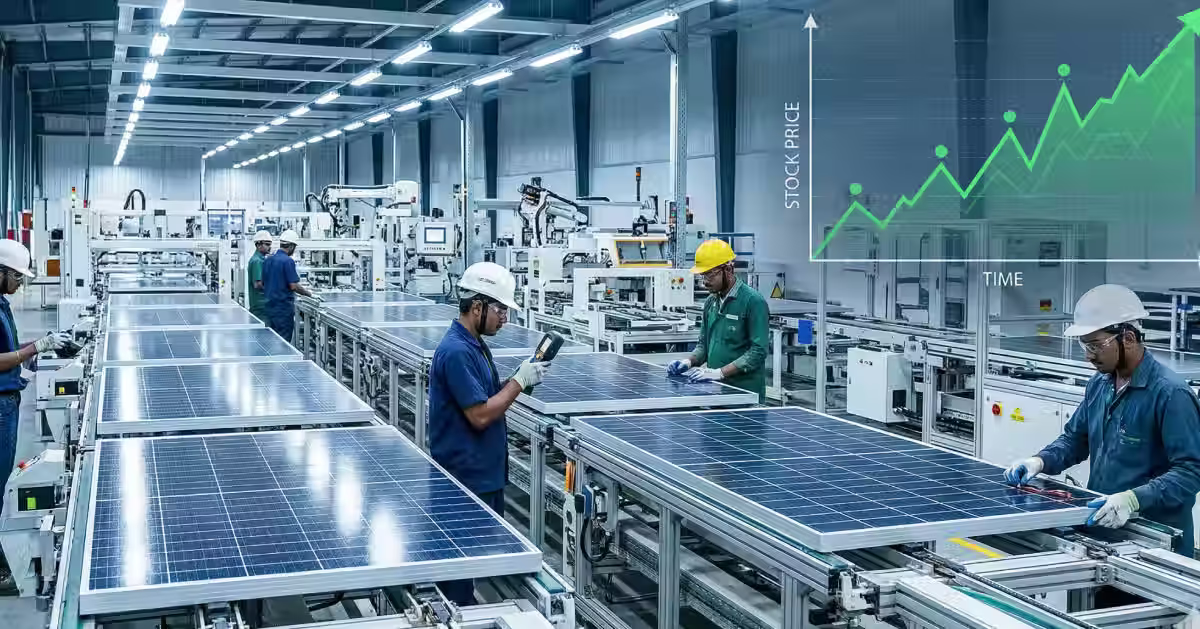
Surat-based solar panel manufacturer Cosmic PV Power has submitted its draft prospectus with SEBI to raise ₹640 crore through an IPO, comprising a fresh issue and an offer for sale component.
Cosmic PV Power Submits IPO Papers to Market Regulator
Cosmic PV Power Private Limited has filed its Draft Red Herring Prospectus with the Securities and Exchange Board of India, marking a significant step toward raising capital through public markets. The Gujarat-based solar panel manufacturer is looking to mobilize funds through a combination of fresh equity issuance and secondary share sale by existing investors.
The proposed initial public offering is structured to raise up to ₹640 crore from the capital markets. This includes a fresh issue of equity shares worth ₹140 crore and an offer for sale amounting to ₹500 crore. The offering represents one of the notable fundraising initiatives in India's renewable energy manufacturing sector during the current financial year.
According to the draft papers filed with the market regulator, the company operates in the solar photovoltaic module manufacturing space. The business focuses on production and supply of solar panels for various applications including rooftop installations and utility-scale projects across India and international markets.
Structure of the Public Offering
The total issue size of ₹640 crore is divided between two distinct components that serve different purposes for the company and its stakeholders. Understanding this structure helps clarify how the capital will flow once the IPO is completed.
The fresh issue component of ₹140 crore will bring new capital into the company's balance sheet. These funds will be directly available to Cosmic PV Power for business expansion, debt reduction, and other corporate purposes as outlined in the objects of the issue section of the prospectus.
The offer for sale portion, valued at ₹500 crore, allows existing shareholders to divest a part of their holdings to public market investors. In an offer for sale, the proceeds go directly to the selling shareholders rather than the company. This mechanism provides liquidity to early investors while broadening the shareholder base of the firm.
Each equity share in the offering carries a face value of ₹5. The actual issue price and price band will be determined closer to the launch of the public subscription period, based on market conditions and valuation discussions between the company and its merchant bankers.
Pre-IPO Placement Under Consideration
The draft prospectus reveals that Cosmic PV Power may consider raising additional capital through a pre-IPO placement. The company, in consultation with its book running lead managers, has the option to raise up to ₹110 crore before filing the final red herring prospectus with the Registrar of Companies.
Pre-IPO placements are conducted before the main public offering opens for subscription. Such placements typically involve institutional investors or high net worth individuals who commit capital at negotiated valuations. Companies use this route to bring in strategic investors or reduce the public offer size while still meeting fundraising targets.
If the pre-IPO placement is executed, the fresh issue size of ₹140 crore will be reduced proportionately to account for the capital already raised. This adjustment ensures compliance with regulatory requirements that govern the minimum public shareholding in a company post-listing.
The flexibility to undertake a pre-IPO placement gives the company room to optimize its capital structure based on investor interest and market dynamics prevailing at the time of the offering.
Planned Utilization of IPO Proceeds
The draft red herring prospectus outlines specific purposes for which the funds raised through the fresh issue will be deployed. Regulatory norms mandate that companies clearly articulate how they intend to use the capital mobilized from public investors.
A significant portion of the proceeds is earmarked for repayment or prepayment of certain borrowings that the company has availed. Reducing debt helps improve the financial health of a business by lowering interest burden and enhancing credit metrics. As of the filing date, the company had indicated plans to use ₹87.87 crore from the fresh issue proceeds toward debt reduction.
Another allocation from the IPO funds will go toward payment of lease rentals and license fees. Manufacturing companies often operate facilities on leased land or under licensing arrangements that require periodic rental payments. Setting aside capital for these commitments ensures operational continuity.
The company has also earmarked a portion of the proceeds for general corporate purposes. This is a standard provision that gives management flexibility to deploy capital for working capital requirements, technology upgrades, business development activities, or unforeseen operational needs that may arise.
The detailed breakup of fund utilization will be available in the final prospectus filed with stock exchanges before the IPO opens for subscription.
Company Background and Business Operations
Founded in 2006, Cosmic PV Power operates from its base in Surat, Gujarat. The company has established itself as a manufacturer of solar photovoltaic modules used in residential, commercial, and industrial applications across India and international markets.
The solar module manufacturing business involves assembling photovoltaic cells into panels that convert sunlight into electricity. These modules form the core component of solar power systems installed on rooftops, open land, and floating platforms for electricity generation.
Cosmic PV Power caters to both the domestic market and exports its products to various countries. The company has been expanding its manufacturing capacity and distribution network to capture growing demand for solar energy solutions driven by government policies and declining technology costs.
According to information available about the company's operations, it has been investing in automation and quality control systems to improve production efficiency and product performance. The solar manufacturing sector is highly competitive, with pricing pressure and technology upgrades being constant factors influencing business dynamics.
In November 2025, the company announced that it had secured orders worth approximately ₹600 crore from Zetwerk Manufacturing Businesses for supply of solar modules. This order book provides revenue visibility and demonstrates the company's ability to secure large-scale contracts from industrial buyers.
Recent Business Developments and Expansion Plans
The company has been actively pursuing growth initiatives in line with India's ambitious renewable energy targets. The government's push toward achieving 500 gigawatts of non-fossil fuel energy capacity by 2030 has created substantial demand for solar panels and related equipment.
Cosmic PV Power has been investing in enhancing its manufacturing capabilities to meet this growing market opportunity. The company reportedly operates manufacturing facilities with capacity to produce solar modules for utility-scale projects as well as distributed generation applications.
The firm has also been focusing on building relationships with engineering, procurement, and construction companies that execute large solar projects. Establishing such partnerships helps secure consistent order flow and reduces dependence on spot market transactions.
In addition to manufacturing, the company provides technical support and after-sales service to its customers. This includes assistance with installation, commissioning, and maintenance of solar power systems that use its modules.
The company's expansion strategy appears to align with industry trends favoring domestic manufacturing. Government incentives such as the Production Linked Incentive scheme for solar modules and the Approved List of Models and Manufacturers requirements have created a supportive environment for Indian manufacturers.
Merchant Bankers and IPO Timeline
The company has appointed Nuvama Wealth Management Limited as the sole book running lead manager for the proposed initial public offering. The merchant banker will be responsible for managing the entire IPO process, from determining the price band to allocation of shares among different investor categories.
Nuvama Wealth Management will conduct roadshows and investor meetings to gauge demand for the offering. Based on feedback from institutional investors and market conditions, the book running lead manager will assist the company in finalizing the issue price.
The firm will also handle the book building process where investors submit bids during the subscription period. Managing the book involves collecting bids, ensuring regulatory compliance, and determining the final allocation methodology.
Link Intime India Private Limited has been designated as the registrar to the issue. The registrar's responsibilities include processing investor applications, managing refunds for unsuccessful bids, and facilitating the transfer of shares to demat accounts of successful applicants.
Following receipt of SEBI's observation letter, the company will file the red herring prospectus with stock exchanges and announce the subscription dates. Typically, companies launch their IPOs within a few weeks to a few months after receiving regulatory approval, depending on market conditions.
The equity shares of Cosmic PV Power are proposed to be listed on both the National Stock Exchange of India and BSE Limited. Listing on both exchanges provides investors with dual trading platforms and enhances liquidity for the stock.
India's Solar Manufacturing Landscape
The Indian solar manufacturing sector has witnessed significant growth in recent years, driven by government policy support and rising domestic demand. The country has been working to reduce dependence on imported solar equipment, particularly from China, by building indigenous manufacturing capacity.
Several policy initiatives have been introduced to support domestic solar manufacturers. The Production Linked Incentive scheme offers financial incentives for solar module and cell manufacturing. The Approved List of Models and Manufacturers requirement mandates that government-supported projects use panels from approved domestic manufacturers.
These measures have led to capacity expansion announcements from both established players and new entrants. The sector has attracted investments from industrial conglomerates, renewable energy developers, and financial investors looking to capitalize on India's clean energy transition.
However, the industry faces challenges including competition from low-cost imports, raw material price volatility, and the need for continuous technology upgrades. Solar panel manufacturing is a capital-intensive business requiring investments in production equipment, quality control systems, and research and development.
The financial performance of solar manufacturers depends on factors such as capacity utilization, raw material costs, pricing power, and ability to secure long-term supply contracts. Companies with scale, technological capabilities, and established distribution networks tend to have competitive advantages.
Market Opportunity and Growth Drivers
India's solar energy sector presents substantial growth opportunities for equipment manufacturers. The country aims to achieve 500 gigawatts of installed renewable energy capacity by 2030, with solar power expected to contribute a significant portion of this target.
Rooftop solar installations are gaining traction in residential and commercial segments. Government incentive programs, net metering policies, and declining system costs have made solar power economically attractive for end consumers. This creates sustained demand for residential and commercial-scale solar modules.
Utility-scale solar projects continue to be awarded through competitive bidding processes. Solar tariffs have become competitive with conventional power sources, leading to regular project announcements. Large projects require substantial quantities of solar modules, providing order book visibility for manufacturers.
The government's focus on promoting domestic manufacturing through schemes like Production Linked Incentives is expected to benefit Indian manufacturers. Preference for domestic suppliers in government-supported projects creates a protected market segment for local players.
Export opportunities are also emerging as global demand for solar equipment continues to grow. Indian manufacturers with competitive pricing and quality certifications can target international markets, particularly in regions where China's dominance is being questioned due to trade policies or supply chain diversification strategies.
Regulatory Considerations and Risk Factors
Investors evaluating the Cosmic PV Power IPO should carefully review the risk factors section of the prospectus once it becomes available. Some common risks in the solar manufacturing business include technological obsolescence, pricing pressure, and dependence on government policies.
The solar industry experiences rapid technological change. New cell technologies and manufacturing processes can make existing production lines less competitive. Companies need to continuously invest in research and development to maintain technological relevance.
Pricing dynamics in the solar module market can be volatile. Excess global capacity, competition from Chinese manufacturers, and fluctuations in raw material costs affect profitability. Manufacturers with limited pricing power may face margin compression during industry downturns.
Government policies play a crucial role in shaping demand. Changes in subsidy programs, net metering regulations, or import duty structures can materially impact market dynamics. Companies are exposed to policy risk as regulatory frameworks continue to evolve.
Working capital requirements in manufacturing businesses can be substantial. Managing inventory, receivables, and supplier payments requires efficient cash flow management. Companies with limited financial flexibility may face liquidity challenges during market stress.
Quality issues or product failures can lead to warranty claims and reputational damage. Solar modules come with long-term performance warranties, and any widespread defects could result in significant financial liabilities for manufacturers.
Investment Considerations
As with any initial public offering, potential investors should conduct thorough due diligence before participating. The red herring prospectus, once filed, will contain detailed financial statements, business descriptions, and risk disclosures that are essential for making informed investment decisions.
Key aspects to evaluate include the company's market position relative to competitors, manufacturing capacity and utilization rates, customer concentration, and dependence on key raw material suppliers. Understanding these factors helps assess business sustainability and competitive positioning.
Financial metrics such as revenue growth, profit margins, return on capital employed, and cash flow generation provide insights into operational efficiency and financial health. Comparing these metrics with industry peers offers perspective on relative performance.
The valuation at which the IPO is priced will be a critical determinant of returns. Investors should assess whether the offer price appropriately reflects the company's growth prospects, competitive position, and risk profile. Comparable company valuations and discounted cash flow analyses can inform valuation judgments.
Post-listing liquidity is another consideration. Companies with smaller free floats or those operating in niche sectors may experience lower trading volumes. This can affect the ability to enter or exit positions at desired price levels.
The track record and credibility of the promoters and management team matter for long-term value creation. Investors should evaluate management's capital allocation decisions, execution capabilities, and transparency in corporate governance practices.
Conclusion
Cosmic PV Power's filing of draft IPO papers represents a significant milestone in the company's journey from a private manufacturing enterprise to a publicly traded entity. The proposed ₹640 crore offering provides the firm with access to growth capital while offering exit opportunities to existing investors.
The company enters the public markets at a time when India's solar manufacturing sector is experiencing policy-driven growth and increasing domestic demand. The government's focus on building indigenous capacity and reducing import dependence creates a favorable backdrop for established players.
However, the industry also faces competitive pressures, technological change, and policy uncertainties that will test the resilience of business models. The company's ability to scale operations, maintain quality standards, and navigate market cycles will determine its long-term success in public markets.
As the regulatory review process unfolds and SEBI issues its observations, more detailed information about the company's operations and financial performance will become available through the final prospectus. Investors should wait for complete disclosures before evaluating the investment opportunity.
The coming weeks will reveal the issue timeline, price band, and other commercial terms of the offering. Market reception during the subscription period will ultimately determine the success of Cosmic PV Power's debut in India's equity capital markets.